
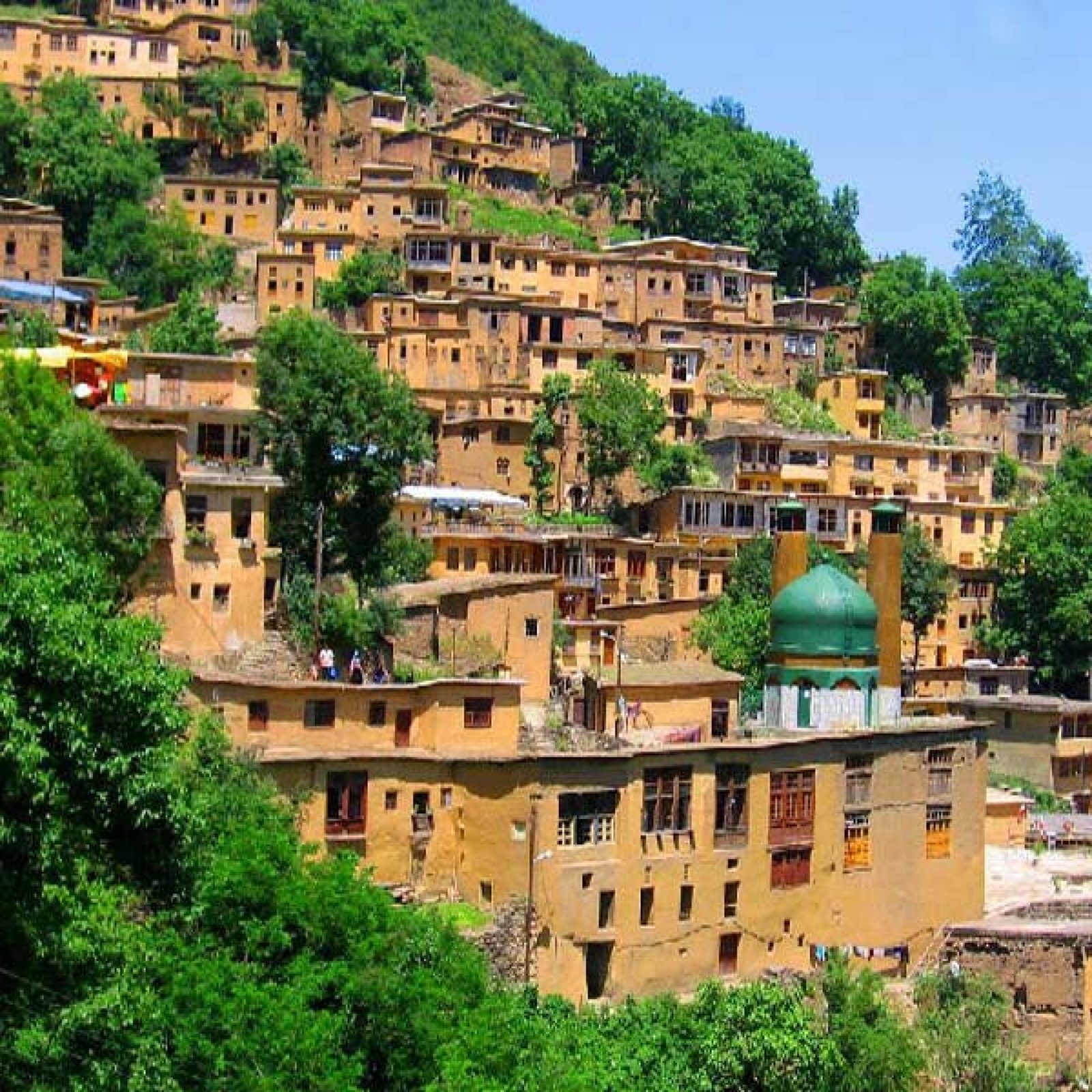
A thousand-year-old village stacked into a misty mountainside, where the roof of one house is the street of the next.
The mist reaches you before the village does. You climb out of the green hills of Gilan, the road folding back on itself through dripping forest, and then — through a thinning curtain of cloud — Masuleh appears all at once: a cascade of ochre-and-yellow houses poured down the mountainside, terrace upon terrace, glowing softly as if lit from within. It is one of those places that looks invented, and yet people have lived here, unhurried, for more than a thousand years.
Masuleh's magic is also its architecture. The village is built so steeply into the slope that the roof of one house serves as the courtyard, garden and public path for the family living above. Around 350 honey-coloured homes step down the hillside in layered tiers, connected not by roads but by stairways, ledges and the rooftops themselves. No cars can enter — they simply could not fit — so the whole place moves at the pace of footsteps. You wander up and over the village rather than through it, and the only traffic is the occasional donkey and the drift of woodsmoke.
Here the roof of one house is the street of the next — a village that has folded a thousand years of life into a single mountainside.
Sitting at around 1,050 metres in the Alborz foothills, Masuleh is often wrapped in the cool, damp mist that rolls in off the Caspian lowlands. The houses are painted that distinctive warm yellow for a practical reason: so they can still be found and seen when the fog settles thick over the valley. Founded around the 11th century, the village once sat on a branch of the old trade routes and grew prosperous on ironwork; today it is celebrated instead as one of the most beautiful corners of Iran's lush, green north, and a candidate for UNESCO World Heritage status.
Follow your nose into the covered lanes of the little bazaar, where stalls spill over with walnuts, herbs, dried fruit and homemade preserves, and tea houses set out platters of kebab and glasses of amber tea. This is some of Iran's finest food and slow-travel territory, and the vendors are as much a part of the experience as the views — generous with a smile, a sample and a story. Linger over a glass of tea on a balcony-that-is-also-a-street and watch the cloud move through the village below. There is nothing to rush towards. That, in the end, is the point of Masuleh.
Masuleh rewards visitors year-round, but it is loveliest in spring, when the surrounding forest turns vivid green and wildflowers appear, and again in autumn, when the hills burn red and gold. It pairs beautifully with Rasht and the Caspian coast on one of our Nature & Caspian journeys, and for questions about the best season, getting around or what to pack, our travel FAQ has you covered. When the mountains start calling, our local experts can fold Masuleh into a private route built around you — just tell us your dates and let's begin.
Published by Arian Tour — Iran travel specialists. Seasonal conditions and access can change; we confirm every detail when planning your trip.
 Plan Your Visit
We'll build a private, tailor-made itinerary around the season and the places that move you most.