
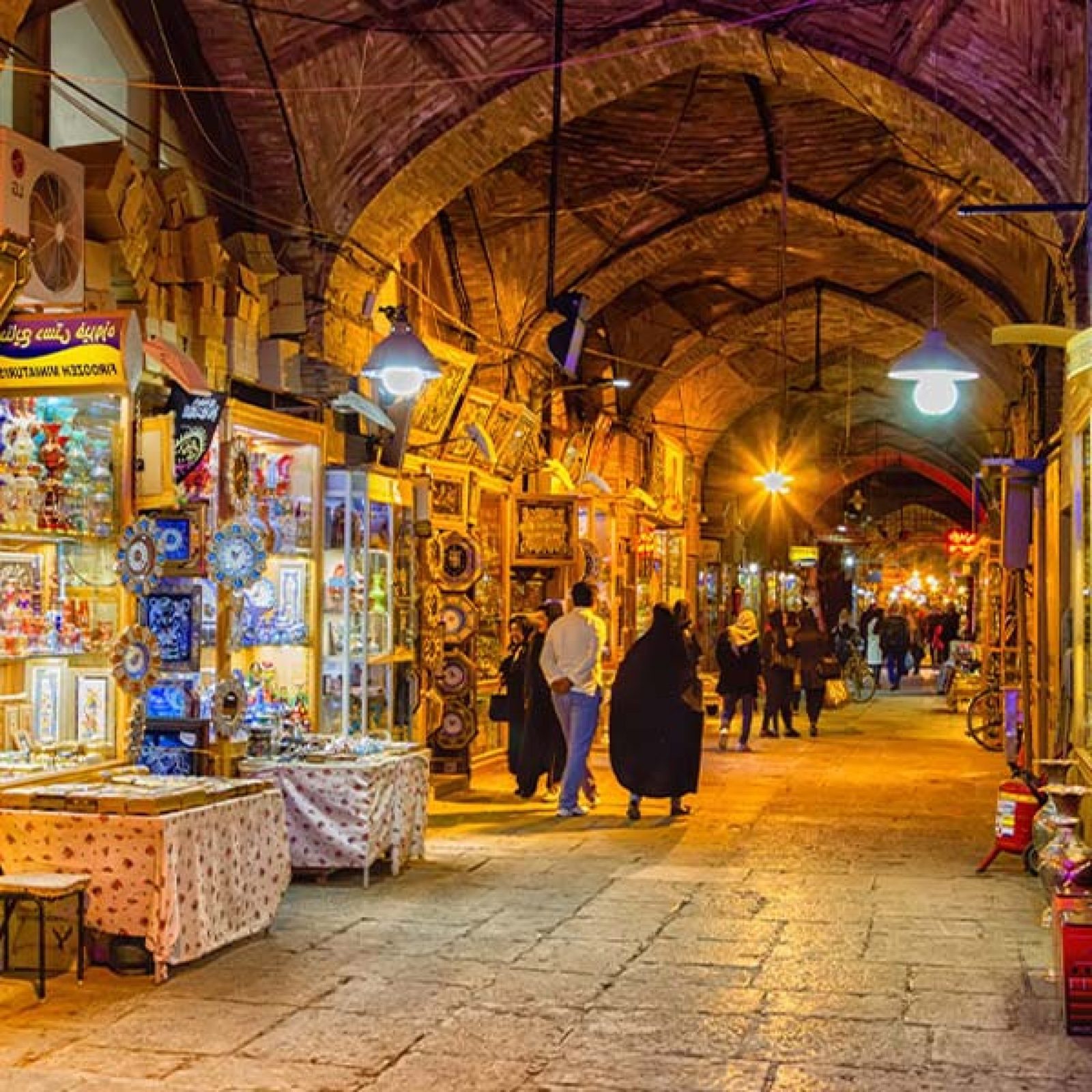
Eleven days along the old caravan road across Persia — domed bazaars, desert caravanserais, oasis cities and the pilgrim shrine at the road's eastern end.
For well over a thousand years, Persia was the middle of the Silk Road — not a stop along it but the long, essential span that connected China and Central Asia to the Mediterranean world. Silk, spices, lapis, paper and porcelain moved west; glass, wool, horses and ideas moved east; and everything paused, was taxed, traded and talked over in the caravan cities of the Iranian plateau. Those cities are still here, and so are the roadside inns that sheltered the caravans: in 2023 UNESCO inscribed a serial property called The Persian Caravanserai, comprising 54 of them across 24 provinces.
This 11-day itinerary follows that eastern-southern arc of the road, running from Tehran down through the oasis towns of the central desert and out to Mashhad, the historic gateway to Central Asia. It is a route built around bazaars and caravanserais rather than palaces alone — good for travellers who want commerce, craft and daily life alongside the monuments. Spring and autumn are the most comfortable seasons; the desert legs are long but scenic, and one domestic flight saves a full day. Here is how the eleven days unfold across our key destinations.
Land in the capital and ease in gently. The National Museum of Iran lays out the plateau's long story in a single morning, and the Qajar-era Golestan Palace shows what the trade routes ultimately paid for. Background in our Tehran city guide.
Iran's largest covered market is a working city in itself — kilometres of lanes for carpets, copper, spices and gold, punctuated by courtyards, mosques and teahouses. It is the best possible introduction to how a Persian bazaar actually works before you meet the older ones further south. See our bazaar experiences.
Leave the capital for the desert-edge oasis of Kashan, long famous for silk, rosewater and tiles. Visit the spring-fed Fin Garden and the great Qajar merchant houses — Tabatabai and Borujerdi — whose scale tells you exactly how profitable the caravan trade could be.
Continue across the plateau to Isfahan, pausing at the old caravan town of Natanz. Arrive by late afternoon and walk the bridges of the Zayandeh River as the light goes gold — a soft first evening in Iran's most beautiful city.
Shah Abbas rebuilt Isfahan as a capital designed to capture the trade routes, and Naqsh-e Jahan Square is the result: mosque, palace and market arranged around one vast rectangle. Spend the day between the Imam and Sheikh Lotfollah mosques and the arcaded bazaar that runs off the square's northern end. Details in our Isfahan guide.
A slower day among the crafts the Silk Road carried: miniature painting, inlaid khatam woodwork, hand-block printing and the ringing alleys of the coppersmiths. Meeting the makers in their own workshops is the point — see our handicraft experiences.
Drive east into true caravan country. Yazd's entire historic centre is UNESCO-listed, a mudbrick maze of wind-towers, water channels and domes; climb to a rooftop at dusk for the most atmospheric skyline in Iran.
Explore the old town, the Jameh Mosque and the Zoroastrian fire temple, then head out to the Zeinoddin caravanserai on the road south — a rare circular Safavid-era inn, restored and still receiving travellers. Staying or simply stopping there is the closest thing to sleeping on the Silk Road itself.
Cross the high desert to Kerman, an old caravan hub and carpet town. Its heart is the Ganjali Khan complex — a Safavid square combining bazaar, caravanserai, bathhouse, mosque and mint, built as a single commercial machine in the early 1600s. Our Deserts & Oases route lingers longest here.
A domestic flight north-east to Mashhad, the great city of Khorasan and the last major Iranian stop before the Central Asian road. Spend the evening at the vast Imam Reza shrine complex, which draws millions of pilgrims a year and glows extraordinarily after dark. See our Mashhad guide.
A last morning for saffron, barberries and turquoise in the bazaar — Khorasan's classic trade goods, still sold much as they always were — before your onward flight home or on to Central Asia.
The caravans are gone, but the road is not: the bazaars still trade, the caravanserais still stand, and the desert between them looks exactly as it did.
Iran's standard circuit — Tehran, Isfahan, Yazd, Shiraz — is deservedly popular, but it is a route about dynasties and monuments. The Silk Road version is about movement and exchange, and it gives a trip a different texture: you spend more time in markets and workshops, more time crossing open desert, and you reach Mashhad and Khorasan, which most first-time visitors never see. It also connects naturally onward to Turkmenistan and Uzbekistan if you are building a longer Central Asian journey.
Picture a fortified courtyard a day's march from the last one — roughly 30 to 40 kilometres — with stabling below, sleeping cells above, a water source and a gate that shut at dusk. Hundreds were built across Persia, most densely under the Safavids, and the 54 now protected as a single World Heritage property range from grand royal commissions to plain brick shelters in the sand. Several have been carefully converted into small hotels, which is why this itinerary can put you inside one rather than merely photographing it.
Eleven days is comfortable for this route but not leisurely: expect two long driving days and one internal flight. Roads are good, and travelling with a private driver-guide means you can stop at the ruined caravanserais and salt flats that make the desert legs memorable. Summer heat on the plateau is serious, so aim for March to May or late September to November. Mashhad's shrine has a strict dress code — women are given a chador at the entrance — and modest dress applies everywhere. Our travel FAQ covers visas, money, connectivity and what to wear.
This is a framework, not a timetable. Add Shiraz and Persepolis at the southern end, swap in the northern branch of the road through Qazvin and the great covered bazaar of Tabriz, or extend into the Caspian green north for a change of climate. Food-focused travellers often pair it with our Food & Bazaars journey, since the route runs through Iran's best market towns; the historic core overlaps closely with Classic Persia. Everything runs privately, at your pace.
The Silk Road is one of those journeys that rewards patience — long horizons, slow bazaar mornings, tea offered in places where tea has been offered for centuries. Tell us your dates and interests and we'll shape the whole route around you: plan my trip.
Published by Arian Tour — Iran travel specialists. Driving times, domestic flight schedules, opening hours and caravanserai accommodation can change; we confirm every detail when planning your trip.
 Plan Your Visit
We'll build a private, tailor-made version of this route — bazaars, caravanserais and desert cities at your own pace.